Most “best wedding venue” articles list hotels, lawns, and banquet halls side by side, as if the only thing that separates them is decor and price. For a traditional South Indian wedding, that comparison misses the point. A muhurtham has a time window. A homam needs ventilation and a fire-safe surface. A Kashi Yatra needs a walking path long enough to mean something. These are not preferences — they are structural requirements that either exist in a venue or don’t.
This guide walks through what each major South Indian wedding ritual actually demands from a venue’s layout, orientation, and logistics, so you can evaluate any shortlist with the right questions — not just photographs.
A South Indian wedding venue needs to support several non-negotiable ritual requirements: a correctly oriented, fire-safe mandapam for the muhurtham and homam, open space for processions like the Kashi Yatra, a separate area for the Oonjal (swing) ceremony, room for a multi-day pre-wedding schedule, and a kitchen capable of serving a traditional vegetarian banana-leaf meal at scale. Meridian by the Lawns, an open-air venue near Bannerghatta, Bangalore, is built around these requirements, with lawn space for up to 5,000 floating guests and dedicated areas for pre-wedding functions.
Why Generic Venue Checklists Don’t Work for South Indian Weddings
Searches for “wedding venues in Bangalore” return a mix of five-star ballrooms, resort lawns, and convention halls built primarily for North Indian formats — baraat entries, sangeet floors, varmala stages. None of that is wrong, but none of it answers the question a South Indian family is actually asking, which is closer to: will this space let the priest do his job, will the smoke from the homam have somewhere to go, and will 200 people be able to sit cross-legged on the floor for the muhurtham without elbowing each other.
A venue can be beautiful and still be wrong for this. The right starting point isn’t “which venue looks best in photos” — it’s “which venue was actually designed around how the ceremony unfolds.”
The Mandapam: Orientation, Ventilation, and Sacred Geometry
The mandapam is the literal centre of a South Indian wedding, and it has three requirements most general-purpose banquet halls were never built to satisfy.
Directional Orientation
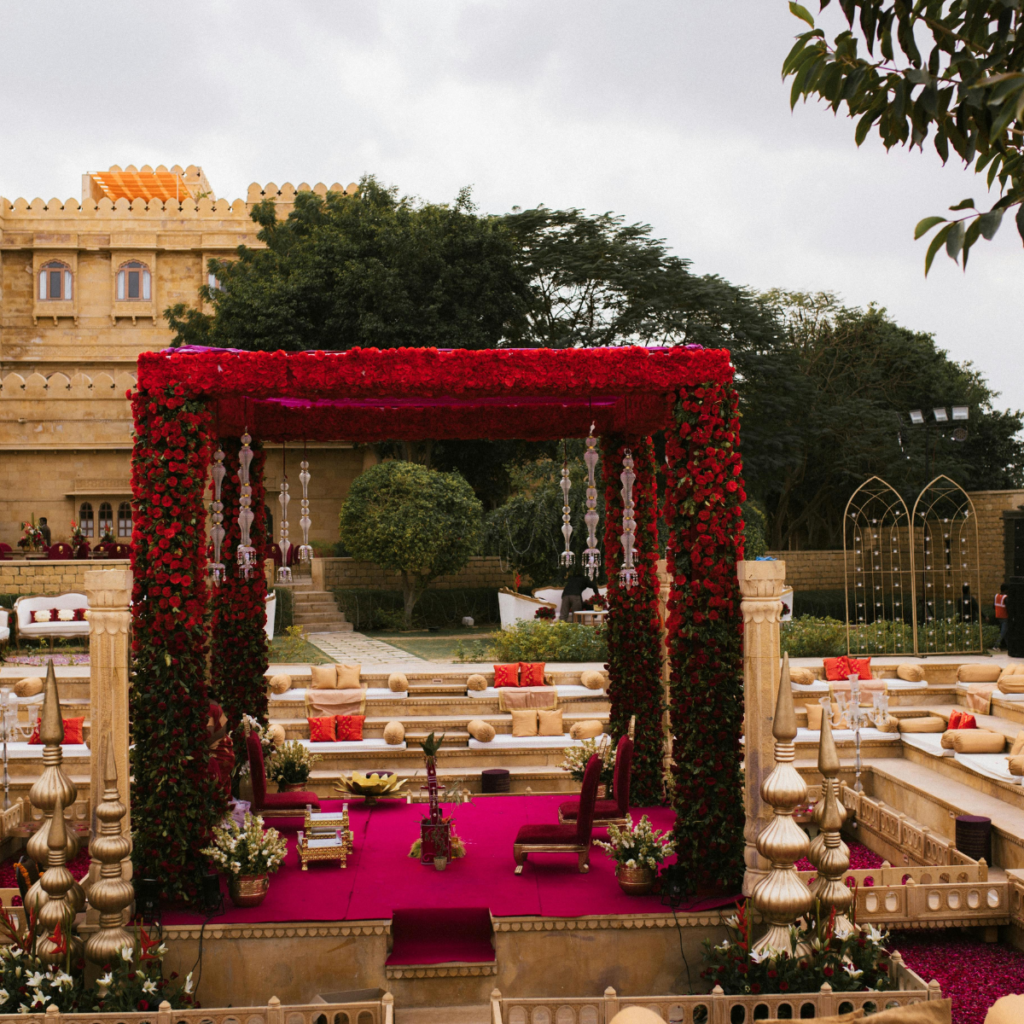
Many South Indian communities prefer the mandapam — and the couple facing east during key rituals — for auspicious alignment during the muhurtham. A hall with a fixed stage position at one end can’t be reoriented for this. An open lawn, by contrast, lets the mandapam structure be positioned to face whichever direction the family’s priest specifies.
Fire Safety and Ventilation for the Homam
The homam (sacred fire ritual) produces real smoke and requires a fire-safe, non-flammable surface beneath the kunda (fire pit), plus enough overhead clearance and airflow that the smoke doesn’t choke the space or trigger indoor fire suppression systems. This is precisely where indoor banquet halls run into trouble: false ceilings, AC ducting, and sprinkler systems are not designed around an open flame ritual. Open-air mandapam settings sidestep this problem entirely — ventilation is never an issue when there’s no ceiling to begin with.
Space for the Officiating Priest and Close Family
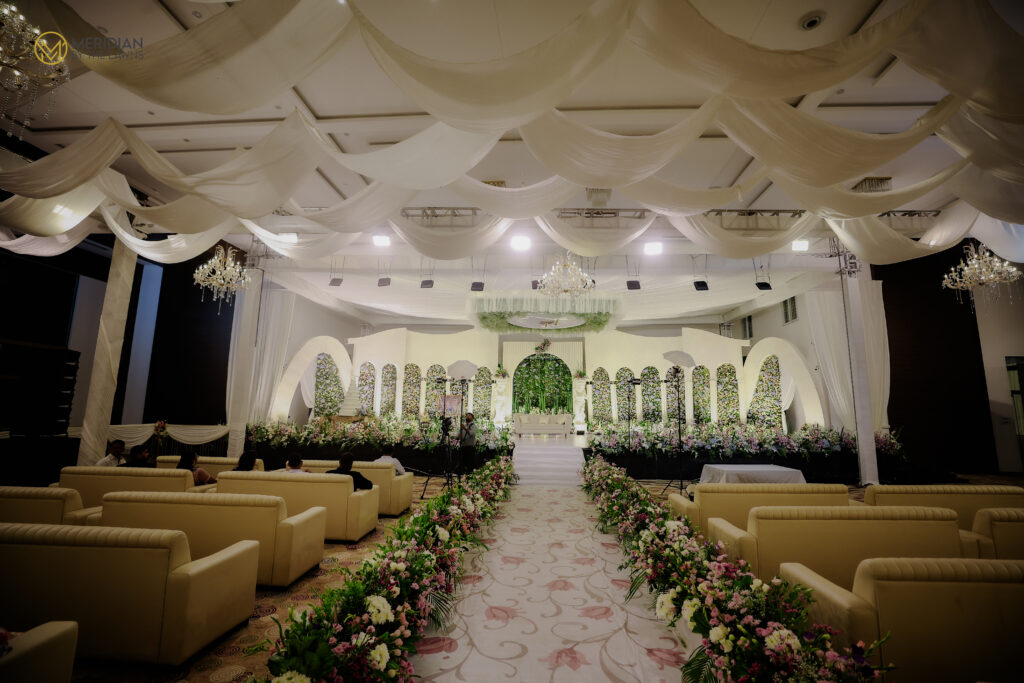
The muhurtham involves the priest, the couple, and immediate family within a tight radius of the mandapam, often seated on the floor. That inner circle needs to be undisturbed by the general guest flow, which means the mandapam needs a buffer zone — not just a stage with seating rows facing it.
The Kashi Yatra: Why Some Venues Can’t Host It Properly
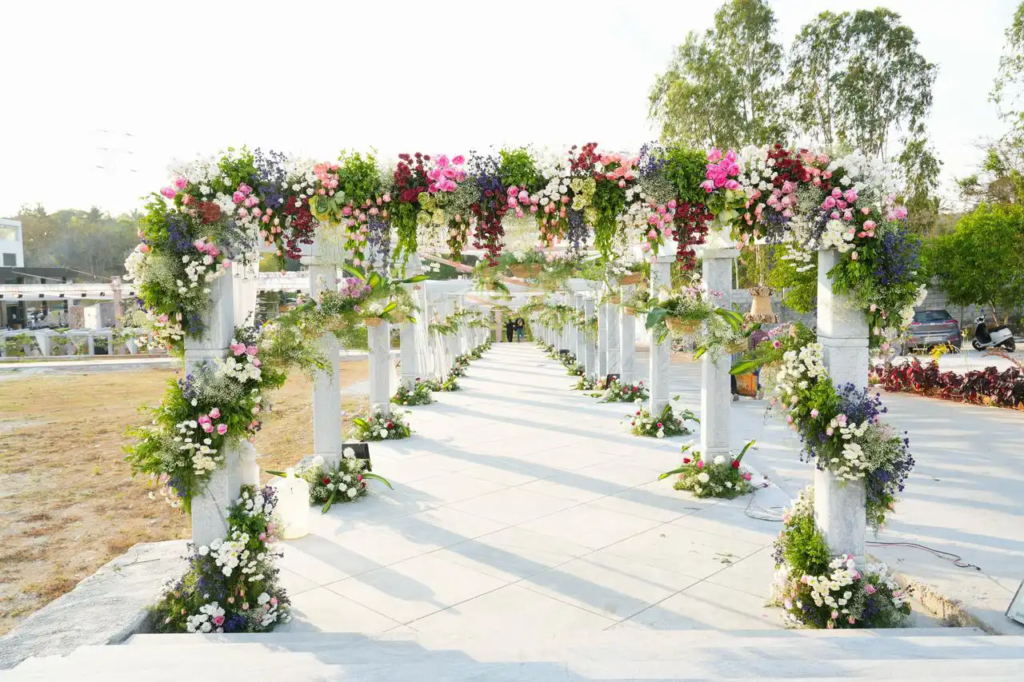
In the Kashi Yatra, the groom symbolically sets off for Kashi (Varanasi) to renounce worldly life, and is intercepted by the bride’s father, who persuades him to marry instead. It’s a procession, which means it needs an actual path — typically 20 to 40 feet of walkable space, ideally outdoors, with enough width for the groom, his entourage, the bride’s father, and onlooking guests to move together without bottlenecking.
A banquet hall with a single stage and rows of round tables has nowhere for this to happen. An open lawn with a clear approach to the mandapam does. This is one of the more visible ways a venue’s physical layout either supports or quietly shrinks a ritual.
The Oonjal Ceremony: A Separate Space, Not a Side Note
The Oonjal (swing ceremony) typically happens before the main muhurtham, with the bride and groom seated on a decorated swing while elders perform aarti and sing traditional songs. It needs its own defined area — distinct from the main mandapam — with enough room for the swing structure itself plus close family gathered around it.
Venues that treat the Oonjal as an afterthought tend to squeeze it into a corner of the main hall, which flattens what’s meant to be an intimate, separate moment in the day’s choreography. A venue with multiple distinct areas — a main ceremony lawn and a separate space for pre-ceremony rituals — keeps the Oonjal as its own moment instead of a rushed transition.
Pre-Wedding Functions Need Their Own Footprint, Not Borrowed Space
A traditional South Indian wedding is rarely a single-day event. Nischayathartham (engagement), Haldi, and sometimes a Sangeet-style evening typically precede the muhurtham, often across two to three days. Booking a venue that only has one usable space means these functions either get compressed into a single evening or pushed into a hotel room — neither of which matches the scale families usually want.
The more useful question to ask a venue isn’t “can you host my wedding,” it’s “how many separate, usable spaces do you have, and can I book them concurrently across my wedding dates.” A venue with one hall and one lawn gives you two options for an entire multi-day event. A venue with a main lawn, a waterside open stage, and a separate banquet area gives you three simultaneous spaces — which is what a real multi-function wedding schedule needs.
Mandapam Hall vs. Open Lawn Venue: A Practical Comparison
Both formats can host a traditional South Indian wedding well. The difference is in what each makes easy versus what each makes you work around.
| Requirement | Indoor Kalyana Mantapa / Hall | Open Lawn Venue |
| Homam ventilation | Limited; depends on ceiling height and AC ducting | Naturally ventilated, no smoke containment issue |
| Mandapam orientation | Fixed by stage position; hard to change | Flexible placement to match required direction |
| Kashi Yatra procession path | Often cramped between seating rows | Open ground allows a full, unhurried procession |
| Multi-day function space | Usually one hall, booked function by function | Multiple zones (lawn, waterside stage, banquet area) usable in parallel |
| Weather dependency | None — fully indoor | Backup covered space recommended for monsoon dates |
| Guest capacity scaling | Fixed by hall dimensions | Scales from intimate to 1,000+ guests by zone |
Catering: Why the Kitchen Matters as Much as the Mandapam
Traditional South Indian wedding catering — sambar, rasam, payasam, served on a banana leaf for hundreds of guests in a single sitting — is a logistics problem most general banquet kitchens aren’t built for. It requires a kitchen sized for high-volume, often fully vegetarian batch cooking, with a serving flow that can move large numbers of guests through a sit-down meal without long waits.
Venues with in-house catering teams who have specifically handled South Indian wedding volumes tend to manage this far more smoothly than those bringing in an outside caterer for the first time. It’s worth asking directly: how many South Indian weddings has your kitchen catered, and what’s the largest sit-down banana-leaf service you’ve run.
How Meridian by the Lawns Is Built Around These Requirements
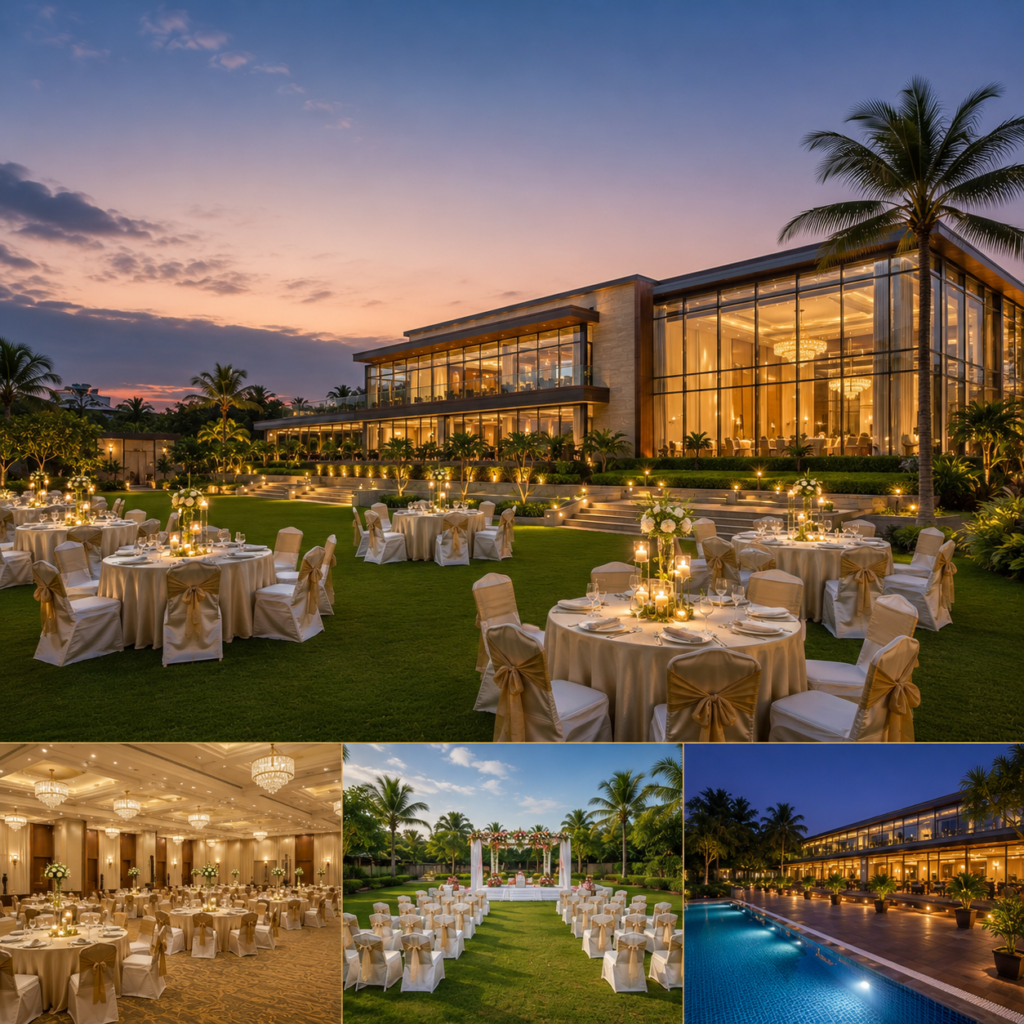
Meridian by the Lawns is an open-air wedding venue near Bannerghatta, Bangalore, designed around exactly the requirements traditional ceremonies bring with them, rather than retrofitted for them.
• Open lawn ceremony space that allows the mandapam to be positioned according to your priest’s required orientation, with no ceiling or ducting to restrict homam ventilation.
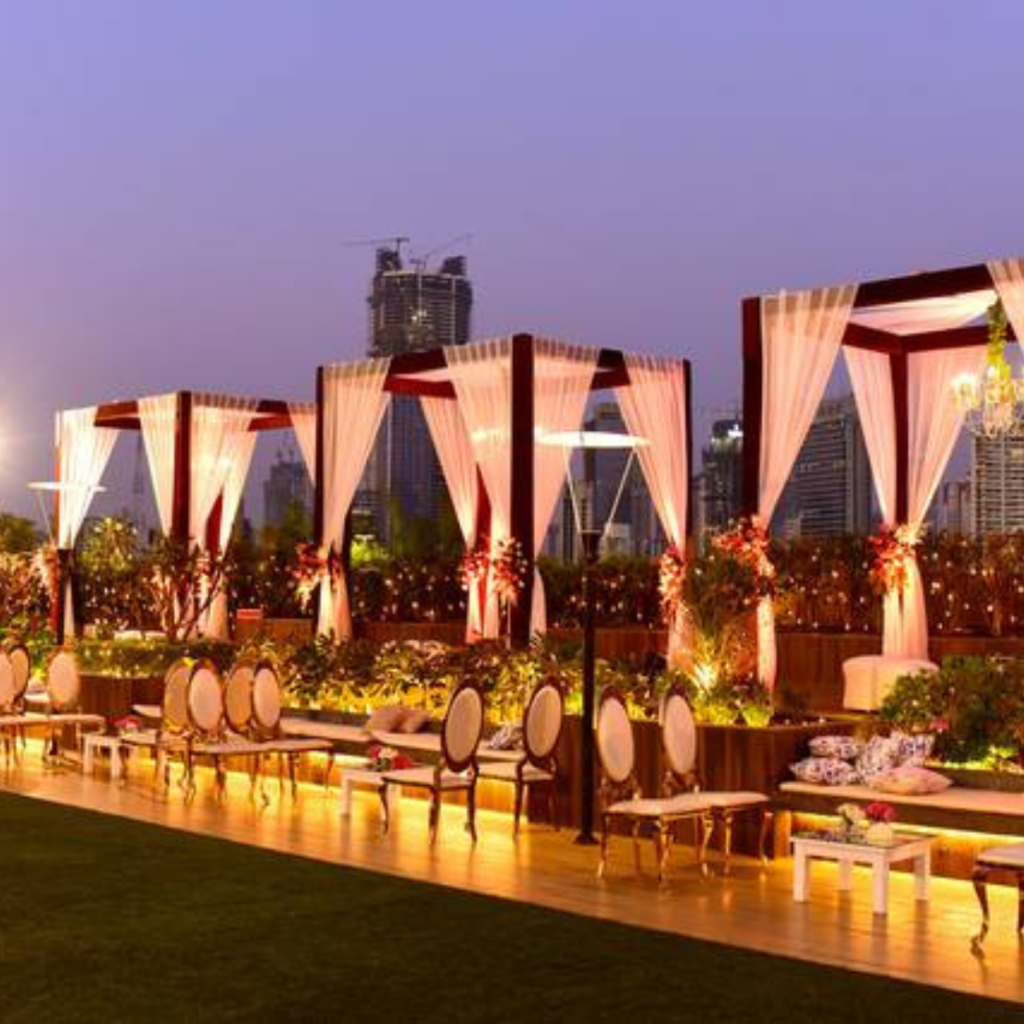
• A separate open stage by the waters, suited to more intimate ceremonies of up to 1,000 guests, that can be used independently of the main lawn for the Oonjal or other pre-ceremony rituals.
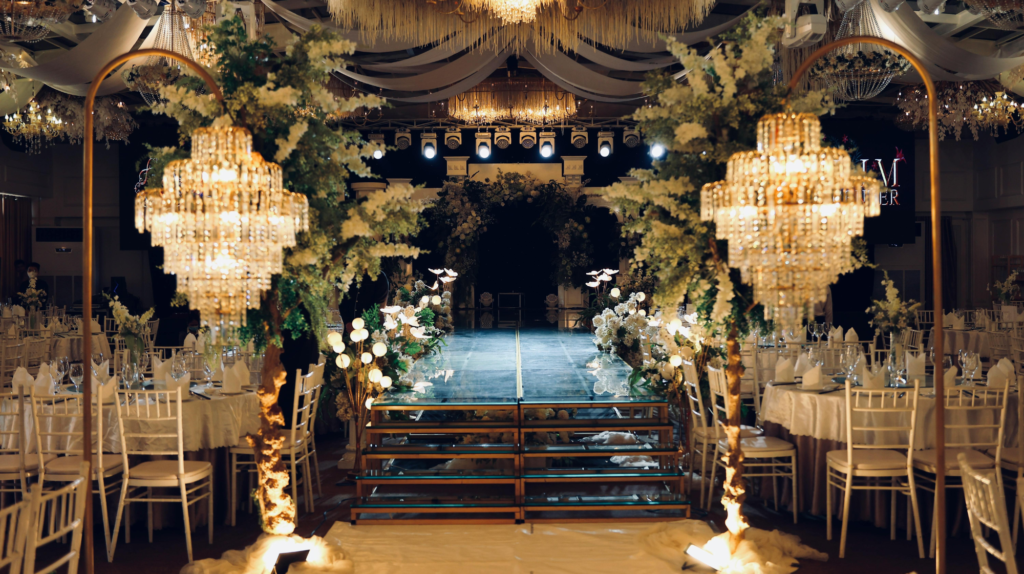
• A grand marriage hall and banquet area with capacity for up to 5,000 floating guests or 2,000 seated guests, giving multi-day weddings room to run Nischayathartham, Haldi, and reception functions without re-booking a single space repeatedly.
• Dedicated pre-wedding ceremony areas across the lawns for Haldi, Mehndi, and Sangeet, planned alongside your family rather than squeezed into leftover space.
• On-site accommodation for 80–100 guests, useful for outstation family attending a multi-day ceremony.
• Experienced event staff who coordinate timing around ceremony schedules — muhurtham timings in particular are time-bound, and venue staff familiar with that constraint make the day run smoother.
If you’re evaluating venues against the requirements above, the practical next step is a site visit where you walk your specific ritual list — muhurtham, homam, Kashi Yatra, Oonjal, and however many pre-wedding functions you’re planning — against the actual layout, not just the photographs.
Frequently Asked Questions
What does a South Indian wedding venue need to have?
At minimum, a correctly orientable mandapam area, fire-safe ventilation for the homam, open space for processional rituals like the Kashi Yatra, a separate zone for the Oonjal ceremony, and a kitchen equipped for high-volume traditional vegetarian catering.
Why do South Indian weddings need a mandapam facing a specific direction?
Many families follow auspicious directional guidelines for the muhurtham, often requiring the couple and the sacred fire to face a specific direction during key moments. Venues with a fixed indoor stage can’t always accommodate this, while open lawn settings allow the mandapam to be built facing the required direction.
Can an open lawn venue host a traditional homam safely?
Yes — open lawns are generally better suited to the homam than enclosed halls, since there’s no ceiling, ducting, or sprinkler system to interact with the fire and smoke, and natural airflow clears smoke without affecting guests.
What is the difference between a kalyana mantapa and a wedding lawn?
A kalyana mantapa is an indoor hall, typically built near or around a temple, with a fixed mandapam stage and dining area. A wedding lawn is an open-air space that allows flexible mandapam placement, larger processional movement, and multiple concurrent zones for different ceremonies across a multi-day wedding.
How much space does a muhurtham ceremony actually need?
Beyond the mandapam structure itself, you need a buffer zone around it for the priest, the couple, and immediate family — generally seated on the floor — kept separate from the general guest seating so the ritual isn’t disrupted by guest movement.
What should I ask a venue before booking for a traditional South Indian wedding?
Ask about mandapam orientation flexibility, fire safety provisions for the homam, available walking space for processions, whether pre-wedding functions can be hosted in a separate area from the main ceremony, and the kitchen’s experience with traditional South Indian catering at your expected guest count.
Plan a Wedding That Honours Every Ritual
If your wedding plan includes a muhurtham, a homam, a Kashi Yatra, and two or three days of pre-wedding functions, the venue question isn’t really about decor — it’s about whether the space was built to hold all of that. Meridian by the Lawns, near Bannerghatta, Bangalore, offers open lawns, a waterside stage, and a grand marriage hall designed to support traditional South Indian ceremonies from the first ritual to the final reception.
Call +91 99806 38937 or visit meridianbythelawns.com/wedding to schedule a site visit and walk your ceremony list against the venue in person.